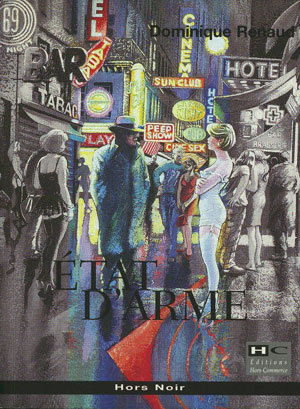
Born in 1961, Renaud was first published in 1995 thriller "Death to appeal."
RENAUD Dominica weapon State, 1998, Trade Off Black Out
Notes: "He put a coin into the slot in the jukebox, selecting a tube of Ray Charles. He had no real choice, and he wanted to hear jazz. Jazz, Renucci loved. One day when he was a kid, his brother had made him listen Mazz Mazzrow (sic) on a phonograph and it had tilt in his ears kid. He had then found an old pipe in a band then retired heated fingers while training at night in a disused basement in the company of a group that did the beef on a Saturday night "(p.10)" It was he who first made him known to Thelonious Monk time or Coleman swore by Ray Charles and Nat King Cole. For the inspector, it had (sic) was a shock, something comparable to those in the 40s, discovered the sound of Bird wondering if it was not an alien "(p.24)" The drummer gave the signal. The quartet began on Cherokee, a standard, Renucci seemed thrilled. He loved the theme of the 40s he had listened the first time performed by Clifford Brown. Musicians experimented with a few riffs before moving to a composition of Monk, while the foot of the inspector continued to beat the [...] Surely he would have preferred a jazz atmosphere, as a banal pop music, to talk with the old. This jazz-there was too generous in that he wanted to think of something else "(p.51-52)" The musicians began on a composition by John Coltrane, in counterpoint to the bebop that had filled the room shortly before "(p.55)" His eyes fell on photos of Bessie Smith and Nina Simone "(p.56)" From the first bars, Coleman acknowledged the trumpet of Chet Baker. A white man who was doing pretty damn good "(p.59) Scene uncensored X:" You know what it reminds me when it is drawn like that? -No. -A Gillespie's trumpet. -Shit what a compliment! "(p.61)" Coleman glanced at the name of musician Miles Davis. He smiles [...] Knowing that his friend refused to listen to a jazz musician who had dared to criticize the game of Monk "(p.91)" Coleman poured a dose ironing in his head the first steps of Naima. Village Vanguard version. New York 1966. These lines were sublime swing reminiscent of a sermon. Renucci had made him listen to several versions, all of John Coltrane. He thought the whole night, almost religious, they had spent together listening to successively Parker and Coltrane "(p.177)" The gramophone was going on and a disc of Bud Powell muted "(p.179) "From the day you brought me in this jazz club for me to see and listen to Thelonious Monk. Himself. In 64, if I'm wrong" (p.181) "He had discovered jazz at age twelve years and had made him enjoy immediately. Saxo-trumpet. A nice pair. The music was linked [...] He loved Clifford Brown, and baltringues night "(p.192).
Also cited: Josephine Baker, Bob Dylan, Juliette Greco.
RENAUD Dominica weapon State, 1998, Trade Off Black Out
Notes: "He put a coin into the slot in the jukebox, selecting a tube of Ray Charles. He had no real choice, and he wanted to hear jazz. Jazz, Renucci loved. One day when he was a kid, his brother had made him listen Mazz Mazzrow (sic) on a phonograph and it had tilt in his ears kid. He had then found an old pipe in a band then retired heated fingers while training at night in a disused basement in the company of a group that did the beef on a Saturday night "(p.10)" It was he who first made him known to Thelonious Monk time or Coleman swore by Ray Charles and Nat King Cole. For the inspector, it had (sic) was a shock, something comparable to those in the 40s, discovered the sound of Bird wondering if it was not an alien "(p.24)" The drummer gave the signal. The quartet began on Cherokee, a standard, Renucci seemed thrilled. He loved the theme of the 40s he had listened the first time performed by Clifford Brown. Musicians experimented with a few riffs before moving to a composition of Monk, while the foot of the inspector continued to beat the [...] Surely he would have preferred a jazz atmosphere, as a banal pop music, to talk with the old. This jazz-there was too generous in that he wanted to think of something else "(p.51-52)" The musicians began on a composition by John Coltrane, in counterpoint to the bebop that had filled the room shortly before "(p.55)" His eyes fell on photos of Bessie Smith and Nina Simone "(p.56)" From the first bars, Coleman acknowledged the trumpet of Chet Baker. A white man who was doing pretty damn good "(p.59) Scene uncensored X:" You know what it reminds me when it is drawn like that? -No. -A Gillespie's trumpet. -Shit what a compliment! "(p.61)" Coleman glanced at the name of musician Miles Davis. He smiles [...] Knowing that his friend refused to listen to a jazz musician who had dared to criticize the game of Monk "(p.91)" Coleman poured a dose ironing in his head the first steps of Naima. Village Vanguard version. New York 1966. These lines were sublime swing reminiscent of a sermon. Renucci had made him listen to several versions, all of John Coltrane. He thought the whole night, almost religious, they had spent together listening to successively Parker and Coltrane "(p.177)" The gramophone was going on and a disc of Bud Powell muted "(p.179) "From the day you brought me in this jazz club for me to see and listen to Thelonious Monk. Himself. In 64, if I'm wrong" (p.181) "He had discovered jazz at age twelve years and had made him enjoy immediately. Saxo-trumpet. A nice pair. The music was linked [...] He loved Clifford Brown, and baltringues night "(p.192).
Also cited: Josephine Baker, Bob Dylan, Juliette Greco.


0 comments:
Post a Comment